Showing posts with label carbon tax. Show all posts

Wednesday, May 28, 2008

Carbon or Carbon Dioixde?: Where to Find Sound Climate Policy

Gristmill explains an importance difference: the precise conversion between carbon and carbon dioxide:
The atomic weight of carbon is 12 atomic mass units, while the weight of carbon dioxide is 44, because it includes two oxygen atoms that each weigh 16. So, to switch from one to the other, use the formula: One ton of carbon equals 44/12 = 11/3 = 3.67 tons of carbon dioxide. Thus 11 tons of carbon dioxide equals 3 tons of carbon, and a price of $30 per ton of carbon dioxide equals a price of $110 per ton of carbon.
Thus, when CTC recommends for 2009 a tax of $37/ton of Carbon - rising gradually to become $370/ton of Carbon by 2019 - this works out to a 2009 tax of $10/ton of CO2 and a 2019 tax of $100/ton of CO2.

The above two sites are careful enough to explain this distinction, which is why there are terrific
sources of information on climate policy. As to official sources, Peter Orszag's CBO Director's Blog is a gem on all matters of public finance, but is particularly strong on climate change. Orszag understands the challenge of climate change and under his leadership CBO has already issued a hugely useful policy study (key finding: for a given amount of economic cost, a carbon tax will achieve roughly five times the carbon emission reductions as a cap-and-trade system....
for the wonks: though the comparison varies depending on how cap-and-trade is structured - whether there is a price "safety valve" for emissions permits, whether permits are bankable - emissions reductions from even the most efficiently designed cap-and-trade system are far more expensive than what is achieved under a carbon tax.

Orszag's leadeship at CBO is estimable, and I take pride that one of his former students - international taxation expert Kim Clausing - taught me at Reed college! We even worked together on a summer research project. Ah, the glory in lineage.

Carbon Tax Center

I just wanted to explain a bit more about the Carbon Tax Center.

CTC's goal is to build public support for a revenue-neutral tax on carbon emissions, meaning a tax on carbon emissions coupled with a reduction in the federal payroll tax or state sales taxes. CTC's preferred tax begins at $37/ton of carbon, and is scaled up over ten years to $370/ton of carbon. Structuring a carbon tax so that it is revenue-neutral offers several advantages:

a) coupled with reductions in the payroll tax, a carbon tax will not make the U.S. tax code more regressive

b) revenue-neutrality will be critical to attracting the political support necessary to get the per unit tax rate high enough where it can make a sufficient dent in emissions

c) existing U.S. subsidies to alternative energy have wrought only harm - namely a boom in corn ethanol that raises food prices, brings no net reduction in carbon emissions, and distorts incentives for producers of genuinely clean energy - thus it makes more sense to return extra revenue to the taxpayers rather than to let lawmakers pursue more wrongheaded subsidies

Read more about these points on the CTC website; maybe even think of someone to fund our conference!

Friday, November 2, 2007

Oil Prices and Clean Energy

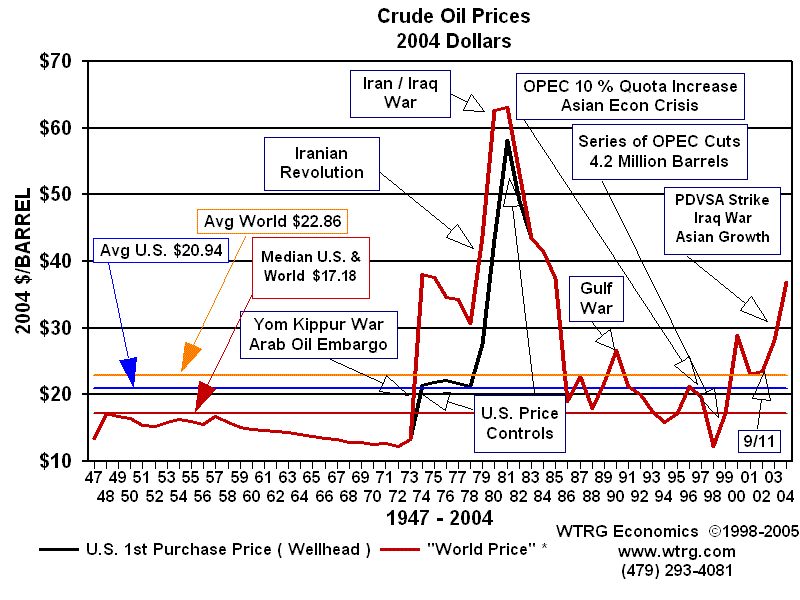
Today NYMEX Crude Oil Futures closed at $96/barrel, meaning that the world price of oil has risen almost seven-fold since it hit a nadir of $14/barrel in 1998. It is tempting to conclude that by raising the threshold per-kilowatt hour price that alternatives to oil must meet in order to be competitive, the surge oil prices will increase production of low-carbon energy sources (wind, biomass, etc.). Thus, one might argue that in the long-run rising oil prices promote de-carbonization of the world's energy supply and reduction of greenhouse gas emissions.

Be wary of this conclusion. Energy producers indeed respond to oil's price signals, but as a discussant on today's NPR Science Friday points out, in the near-term higher oil prices will serve mainly to stimulate production of coal, earth's
most carbon-intensive energy source. For most activities dependent on oil, coal is the cheapest and most plentiful alternative - on a kilowatt hour basis much cheaper than wind, solar, or any of the bio-fuels examined in National Geographic's excellent survey of the subject. As these graphs show, recent gains in the price of coal have lagged far behind those in the price of oil.

Higher oil-prices make low-carbon energy sources more attractive relative to oil, but do nothing to improve their economic viability viz. coal (except insofar as oil is a minor input into coal production). Coal's low price makes it the substitute energy source of choice for almost all users of oil and natural gas; its abundance throughout the world (particularly in China) means that its favored status is unlikely to dissipate anytime soon. To achieve market share, the per unit price of any low-carbon energy source must be able to compete with coal (as Stephen Chu of Berkeley often points out). Incentivizing production of low-carbon energy thus requires raising the price of
all carbon-intensive energy sources (oil, coal, natural gas, etc.) - a rise in the price of oil alone will not do it.

The Royal Commission on Environmental Pollution calculates that a carbon tax of $40/metric ton would make low-carbon sources competitive with coal on an industrial scale. Gilbert Metcalf of Tufts recommends $15/metric ton. Whatever your preferred amount, the influence of coal-producing states in the U.S. Senate (Byrd and Rockefeller of West Virginia; Specter of Pennsylvania) makes any American carbon tax unlikely in the near future. Note that the Lieberman-Warner climate bill forgoes a carbon tax completely in favor of the far inferior cap-and-trade approach.