Showing posts with label Climate Change. Show all posts

Wednesday, May 28, 2008

Carbon or Carbon Dioixde?: Where to Find Sound Climate Policy

Gristmill explains an importance difference: the precise conversion between carbon and carbon dioxide:
The atomic weight of carbon is 12 atomic mass units, while the weight of carbon dioxide is 44, because it includes two oxygen atoms that each weigh 16. So, to switch from one to the other, use the formula: One ton of carbon equals 44/12 = 11/3 = 3.67 tons of carbon dioxide. Thus 11 tons of carbon dioxide equals 3 tons of carbon, and a price of $30 per ton of carbon dioxide equals a price of $110 per ton of carbon.
Thus, when CTC recommends for 2009 a tax of $37/ton of Carbon - rising gradually to become $370/ton of Carbon by 2019 - this works out to a 2009 tax of $10/ton of CO2 and a 2019 tax of $100/ton of CO2.

The above two sites are careful enough to explain this distinction, which is why there are terrific
sources of information on climate policy. As to official sources, Peter Orszag's CBO Director's Blog is a gem on all matters of public finance, but is particularly strong on climate change. Orszag understands the challenge of climate change and under his leadership CBO has already issued a hugely useful policy study (key finding: for a given amount of economic cost, a carbon tax will achieve roughly five times the carbon emission reductions as a cap-and-trade system....
for the wonks: though the comparison varies depending on how cap-and-trade is structured - whether there is a price "safety valve" for emissions permits, whether permits are bankable - emissions reductions from even the most efficiently designed cap-and-trade system are far more expensive than what is achieved under a carbon tax.

Orszag's leadeship at CBO is estimable, and I take pride that one of his former students - international taxation expert Kim Clausing - taught me at Reed college! We even worked together on a summer research project. Ah, the glory in lineage.

Carbon Tax Center

I just wanted to explain a bit more about the Carbon Tax Center.

CTC's goal is to build public support for a revenue-neutral tax on carbon emissions, meaning a tax on carbon emissions coupled with a reduction in the federal payroll tax or state sales taxes. CTC's preferred tax begins at $37/ton of carbon, and is scaled up over ten years to $370/ton of carbon. Structuring a carbon tax so that it is revenue-neutral offers several advantages:

a) coupled with reductions in the payroll tax, a carbon tax will not make the U.S. tax code more regressive

b) revenue-neutrality will be critical to attracting the political support necessary to get the per unit tax rate high enough where it can make a sufficient dent in emissions

c) existing U.S. subsidies to alternative energy have wrought only harm - namely a boom in corn ethanol that raises food prices, brings no net reduction in carbon emissions, and distorts incentives for producers of genuinely clean energy - thus it makes more sense to return extra revenue to the taxpayers rather than to let lawmakers pursue more wrongheaded subsidies

Read more about these points on the CTC website; maybe even think of someone to fund our conference!

Wednesday, November 14, 2007

NYT Environmental Blogs

Continuing my practice of simply stealing material from the Times, check of NYT reporter Andrew Revkin's new blog on climate change. Take note, Jason Islas, this will be a good source of information on the environment (though its use of phrases such as "clean air" may require some explaining to you Angelinos).

This NYT blog covers the environment from a business perspective. Also good.

Friday, November 2, 2007

Shortcomings of the IPCC

To milk one final post from today's Science Friday, the program ended by considering the limitations of the Intergovernmental Panel on Climate Change (IPCC, which shared this year's Nobel Peace Prize with Al Gore). IPCC reports have been invaluable in informing public debate about climate change; the nature of the IPCC, however, ensures that its estimates always err on the side of being too conservative, and that its reports rarely include the most up-to-date climate research.

The reason for these deficiencies is that the IPCC, being a U.N. sponsored organization (open to representatives from all member nations of the UN Environment Program), operates through consensus. Every word and figure in the report must be vetted and approved by representatives from dozens of countries. The need to garner consensus pushes the IPCC to be conservative in its forecasts of future warming, perhaps more so than is justified by the evidence; evaluating the latter point is difficult, since by the time the painstaking process of completing an IPCC report is complete, the state of climate research has almost surpassed what is contained in the report.

I am not suggesting that the IPCC can depart from its consensus-driven M.O.; consensus is what has enabled the IPCC's reports to become so authoritative, respected, and uncontroversial. I am suggesting, however, that Bill McKibben is right to warn that basing climate policy solely on IPCC reports may leave us with policies insufficiently robust to forestall future warming (and vulnerable to low-probability but high-impact climate disruptions). Heeding only the IPCC also ensures that our policy proposals will to some extent be based on outdated science. While the Nobel Committee was right to celebrate the work of the IPCC, we should also acknowledge the IPCC's limitations as a forecaster of climate fluctuations and purveyor of climate science.

Climate Change Means Coal

Beyond the price signals discussed in my last post, today's Science Friday discussion generally centered on coal's centrality to the climate change issue. Its appeal as an energy source I have already stated: it is cheap and plentiful. America already derives half of its electricity from coal; with its infamously large coal reserves, China is apparently building a new coal-fired power plant every ten days.

All the guests endorsed far more investment in equipping coal plants with carbon-sequestration technology. Carbon capture-and-storage basically involves trapping CO2 at the point of emission, then drilling it into subterranean storage spaces (such as spent oil wells). Though workable in laboratory demonstrations, there is not yet a single commercial coal plant in existence today that deploys sequestration technology.

Christopher Field of Stanford emphasized the enormous logistical challenges involved in implementing sequestration technology on an industrial scale: to sequester even 10 percent of the world's coal-based carbon emissions would apparently require an infrastructure as expensive as that of the entire global oil and gas industry. Hearing this reminded me of Tom Friedman's insistence that the world hasn't yet comprehended what it will mean to enact climate prevention strategies on a commercial scale.

Steve Rayner of Oxford advocated diffusion of carbon capture technology as a perfect way to bring China and India into the climate change fold. He noted that in China coal emissions impose enormous public health costs - such as acid rain and respiratory illness - and that the prospect of stopping this harm gives China a reason to want to sequester coal emissions even independent of climate change considerations. Maybe. In my understanding Sulfur Dioxide, rather than Carbon Dioxide, is the element in coal most damaging to human health. I also believe it is possible to sequester sulfur emissions without sequester carbon emissions - the U.S. has long had a cap-and-trade system for SO2 emissions but not one for CO2 emissions (which is coal plants in the U.S. pollute far less than their Chinese counterparts). Maybe capturing CO2 emissions entails capturing SO2 as well - I don't know. I'd like to find out.

Steve Rayner also argued that while we work to prevent climate change by reducing carbon emissions, we must also get realistic about adapting to its consequences. Given our current failure to reduce global CO2 (or even slow the rate of emissions growth), it is highly probable that some alterations to the global climate will occur. These range from the spectacular - such as melting ice sheets, rising sea levels, and the inundation of coastal cities - to the less spectacular but no less insidious - such as accelerated depletion of freshwater in the American West and the spread of malaria to areas previously safe from the disease. Though it is difficult to judge the probability of these events, billions of (often very poor) people are at risk. The World Bank has recently become more active in helping countries prepare for climate disruptions, and their efforts are welcome.

Oil Prices and Clean Energy

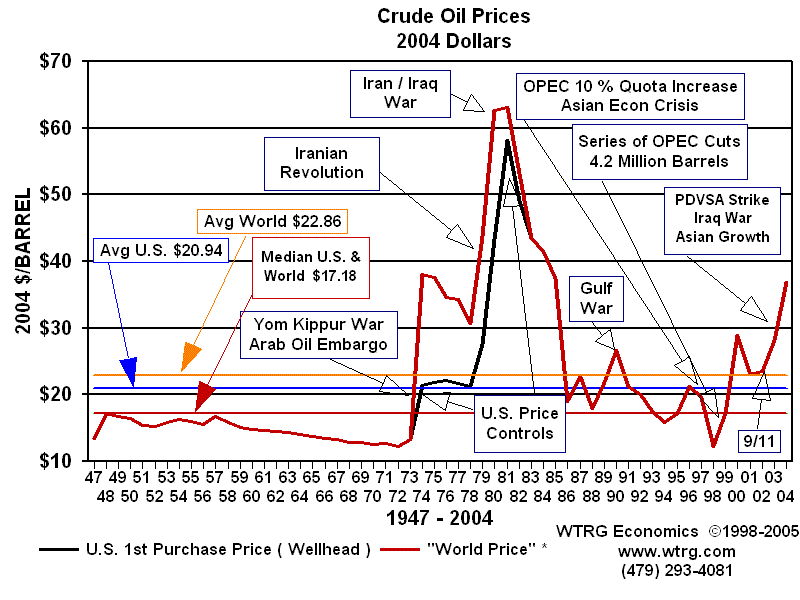
Today NYMEX Crude Oil Futures closed at $96/barrel, meaning that the world price of oil has risen almost seven-fold since it hit a nadir of $14/barrel in 1998. It is tempting to conclude that by raising the threshold per-kilowatt hour price that alternatives to oil must meet in order to be competitive, the surge oil prices will increase production of low-carbon energy sources (wind, biomass, etc.). Thus, one might argue that in the long-run rising oil prices promote de-carbonization of the world's energy supply and reduction of greenhouse gas emissions.

Be wary of this conclusion. Energy producers indeed respond to oil's price signals, but as a discussant on today's NPR Science Friday points out, in the near-term higher oil prices will serve mainly to stimulate production of coal, earth's
most carbon-intensive energy source. For most activities dependent on oil, coal is the cheapest and most plentiful alternative - on a kilowatt hour basis much cheaper than wind, solar, or any of the bio-fuels examined in National Geographic's excellent survey of the subject. As these graphs show, recent gains in the price of coal have lagged far behind those in the price of oil.

Higher oil-prices make low-carbon energy sources more attractive relative to oil, but do nothing to improve their economic viability viz. coal (except insofar as oil is a minor input into coal production). Coal's low price makes it the substitute energy source of choice for almost all users of oil and natural gas; its abundance throughout the world (particularly in China) means that its favored status is unlikely to dissipate anytime soon. To achieve market share, the per unit price of any low-carbon energy source must be able to compete with coal (as Stephen Chu of Berkeley often points out). Incentivizing production of low-carbon energy thus requires raising the price of
all carbon-intensive energy sources (oil, coal, natural gas, etc.) - a rise in the price of oil alone will not do it.

The Royal Commission on Environmental Pollution calculates that a carbon tax of $40/metric ton would make low-carbon sources competitive with coal on an industrial scale. Gilbert Metcalf of Tufts recommends $15/metric ton. Whatever your preferred amount, the influence of coal-producing states in the U.S. Senate (Byrd and Rockefeller of West Virginia; Specter of Pennsylvania) makes any American carbon tax unlikely in the near future. Note that the Lieberman-Warner climate bill forgoes a carbon tax completely in favor of the far inferior cap-and-trade approach.

Wednesday, October 24, 2007

Geoengineering as a Solution to Climate Change

Scientist Ken Caldeira makes the case for "geo-engineering" - shooting trillions of small particles of sulfate into the stratosphere as a way to reflect sunlight and cool the earth's temperature - as a last-ditch way to mitigate climate change without reducing carbon dixoide emissions. Such proposals are controversial - because the engineering problems are formidable, because sulfate is a harmful substance, and because of the fear that people will seize on geo-engineering as an excuse to ignore CO2 reduction. Nonetheless, I think Caldeira frames research into geo-engineering correctly - as an insurance policy that we ought to have in case we cannot resolve the economic and political challenges of controlling emissions.

The idea of geo-engineering first came to my attention through this WSJ article; it stuck in my mind because game theorist and Nobel laureate Thomas Schelling is a geo-engineering advocate (and presumably he knows a thing or two about collective action problems of the kind that bedevil climate agreements). Schelling briefly discusses the idea in his survey of climate policies here (see Kenneth Arrow's review of economics of climate change in same volume).