Led by Bob Rubin, a bipartisan group of former government officials gathered yesterday to playact a Presidential response to a nightmare energy scenario circa 2009: disruptions in the Caspian, confrontation with Iran and Venezuela, oil at $150/barrel, rationing, military urging reinstatement of the draft. NYT reports.
Though basically a publicity stunt, the event underscored how America's mammoth appetite for foreign oil (and Bush's unwillingness to curb this appetite) could spell disaster for whoever occupies the White House in 2008. This article is perhaps most instructive when considered alongside another excerpt from today's NYT business section. Apparently a federal judge has ruled that the Interior Department lacks authority to force energy companies to pay royalties on oil and gas they drill in publicly owned waters in the Gulf of Mexico. More accurately, that Interior lacks authority to withdraw previously granted exemption from royalty payments (usually 12 to 16 percent of sales) even though Congress intended for such royalty relief to cease if the market price of oil climbs above $34/barrel (today oil futures closed at $96/barrel).
Though I have not studied the nuances of the law in question, with a group of former policymakers calling for reform of America's dysfunctional energy policies, Interior being unable to end what is a now a useless and wasteful policy (GAO estimates continued royalty relief could cost the government $60 billion over twenty years) is not an auspicious sign.
Spare me the argument that royalty relief is actually in the spirit of the Rubin group's advocacy because it promotes domestic oil production. With oil prices on this trajectory firms will be pumping oil wherever they can find it even without government subsidies (to wit, see this NYT article on the revival of once defunct Texas oil fields). We would enhance energy security far more using the $60 at issue to fund increased energy efficiency (e.g. supporting tax credits for purchase of energy efficient equipment and appliances).
Showing posts with label energy. Show all posts
Showing posts with label energy. Show all posts
Friday, November 2, 2007


Oil Prices and Clean Energy
Today NYMEX Crude Oil Futures closed at $96/barrel, meaning that the world price of oil has risen almost seven-fold since it hit a nadir of $14/barrel in 1998. It is tempting to conclude that by raising the threshold per-kilowatt hour price that alternatives to oil must meet in order to be competitive, the surge oil prices will increase production of low-carbon energy sources (wind, biomass, etc.). Thus, one might argue that in the long-run rising oil prices promote de-carbonization of the world's energy supply and reduction of greenhouse gas emissions.
Be wary of this conclusion. Energy producers indeed respond to oil's price signals, but as a discussant on today's NPR Science Friday points out, in the near-term higher oil prices will serve mainly to stimulate production of coal, earth's most carbon-intensive energy source. For most activities dependent on oil, coal is the cheapest and most plentiful alternative - on a kilowatt hour basis much cheaper than wind, solar, or any of the bio-fuels examined in National Geographic's excellent survey of the subject. As these graphs show, recent gains in the price of coal have lagged far behind those in the price of oil.
Higher oil-prices make low-carbon energy sources more attractive relative to oil, but do nothing to improve their economic viability viz. coal (except insofar as oil is a minor input into coal production). Coal's low price makes it the substitute energy source of choice for almost all users of oil and natural gas; its abundance throughout the world (particularly in China) means that its favored status is unlikely to dissipate anytime soon. To achieve market share, the per unit price of any low-carbon energy source must be able to compete with coal (as Stephen Chu of Berkeley often points out). Incentivizing production of low-carbon energy thus requires raising the price of all carbon-intensive energy sources (oil, coal, natural gas, etc.) - a rise in the price of oil alone will not do it.
The Royal Commission on Environmental Pollution calculates that a carbon tax of $40/metric ton would make low-carbon sources competitive with coal on an industrial scale. Gilbert Metcalf of Tufts recommends $15/metric ton. Whatever your preferred amount, the influence of coal-producing states in the U.S. Senate (Byrd and Rockefeller of West Virginia; Specter of Pennsylvania) makes any American carbon tax unlikely in the near future. Note that the Lieberman-Warner climate bill forgoes a carbon tax completely in favor of the far inferior cap-and-trade approach.
Be wary of this conclusion. Energy producers indeed respond to oil's price signals, but as a discussant on today's NPR Science Friday points out, in the near-term higher oil prices will serve mainly to stimulate production of coal, earth's most carbon-intensive energy source. For most activities dependent on oil, coal is the cheapest and most plentiful alternative - on a kilowatt hour basis much cheaper than wind, solar, or any of the bio-fuels examined in National Geographic's excellent survey of the subject. As these graphs show, recent gains in the price of coal have lagged far behind those in the price of oil.
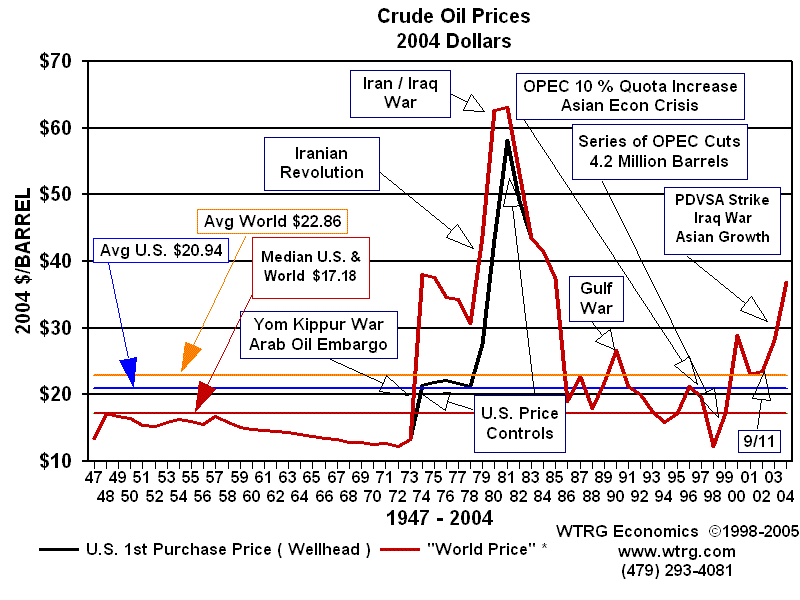
Higher oil-prices make low-carbon energy sources more attractive relative to oil, but do nothing to improve their economic viability viz. coal (except insofar as oil is a minor input into coal production). Coal's low price makes it the substitute energy source of choice for almost all users of oil and natural gas; its abundance throughout the world (particularly in China) means that its favored status is unlikely to dissipate anytime soon. To achieve market share, the per unit price of any low-carbon energy source must be able to compete with coal (as Stephen Chu of Berkeley often points out). Incentivizing production of low-carbon energy thus requires raising the price of all carbon-intensive energy sources (oil, coal, natural gas, etc.) - a rise in the price of oil alone will not do it.
The Royal Commission on Environmental Pollution calculates that a carbon tax of $40/metric ton would make low-carbon sources competitive with coal on an industrial scale. Gilbert Metcalf of Tufts recommends $15/metric ton. Whatever your preferred amount, the influence of coal-producing states in the U.S. Senate (Byrd and Rockefeller of West Virginia; Specter of Pennsylvania) makes any American carbon tax unlikely in the near future. Note that the Lieberman-Warner climate bill forgoes a carbon tax completely in favor of the far inferior cap-and-trade approach.
Subscribe to:
Posts (Atom)